The Long Run
A solo exhibition by Michael MacGarry
Everard Read Gallery, Franschhoek
13 September – 12 October 2025
Artist’s statement:
I am reliably informed that to survive in the art world as an artist, it is best to cultivate two essential traits: an unyielding commitment to self-importance, and the ability to write about their own work with the arid detachment of an actuary explaining the flaws in a pension plan. In opposition, this text—and its accompanying exhibition—are not a shout but a resistance to such imperatives—a sustained, low hum on the anxieties and elegant absurdities of contemporary life.
The Long Run is less an exhibition and more the latest instalment in a personal, pathological rumination on entropy, labour and the desperate invention of our own human significance. These are the uncomfortable by-products of a conversation I’ve been having with myself for some time, that is occasionally interrupted by the inconvenient necessity of making tangible ‘things’. These things then subject to the seemingly never-ending cyclical nature of commodification, and the easing of tensions between our notions of authenticity with that of the spectacle.
Ultimately, of course, the exhibition’s title is the punchline—taken from economist John Maynard Keynes’ dry observation that “in the long run, we are all dead”. While it is the single most honest appraisal of the global economy I’ve ever encountered, Keynes’s unflinching statement is not an opinion; but a diagnosis. This exhibition of mine, then, is not a protest but a post-mortem of an abstract predicament still actively being lived through. The elegant, terrible structures of our obsolescence briefly illuminated on our long march toward oblivion.
The Long Run isn’t concerned with resolution, but accumulation—of meaning, of risk, of the quiet violence embedded in economic systems. It’s about the tension between survival and collapse. And ultimately, it’s about what it means to live with—and within—structures that promise prosperity but are built on exclusion. All of this is paired with a persistent, quiet inquiry into a purpose for being that exists outside the hollow calculus of mere consumption.
The exhibition presents new works from my ongoing Tontine series, accompanied by sculptures in polyurethane, steel and found objects. A tontine, for those who haven’t had the pleasure of contemplating its bizarre logic, is a 17th-century financial scheme where participants contribute to a monetary fund and then proceed to receive payouts until only one person is left standing, literally. To me, it serves as a grotesque metaphor for the current global economic game—a zero-sum death match disguised as mutual prosperity – cut through by the absurd, yet widely accepted, premise of a global economy based on infinite growth in a world that, for all its wonders, remains stubbornly finite.
The works from my Tontine series form the exhibition’s conceptual backbone and continue to mine that fertile ground between personal biography and structural critique that has, in my case, historically involved a kind of aesthetic necropsy of industrial alienation. The sense that modern economies treat human beings not as citizens but as increasingly defective cogs in a machine too big to fail and too blind to notice. The materials I chose, essentially trash (reclaimed and salvaged packaging paper: cement bags, potato sacks and fast food bags)—within my Tontine series reflect the precarity of bodies under systems of dominance, the disposability of labour, pulled through themes of supernatural violence and death. The reclaimed packaging paper, for instance, suggests commerce and trade, while the archival tape gestures toward the institutional—an attempt to preserve, classify, and control the narrative of who we are, and who gets remembered. How control is naturalised and sustained—through language, law, economy and even art.
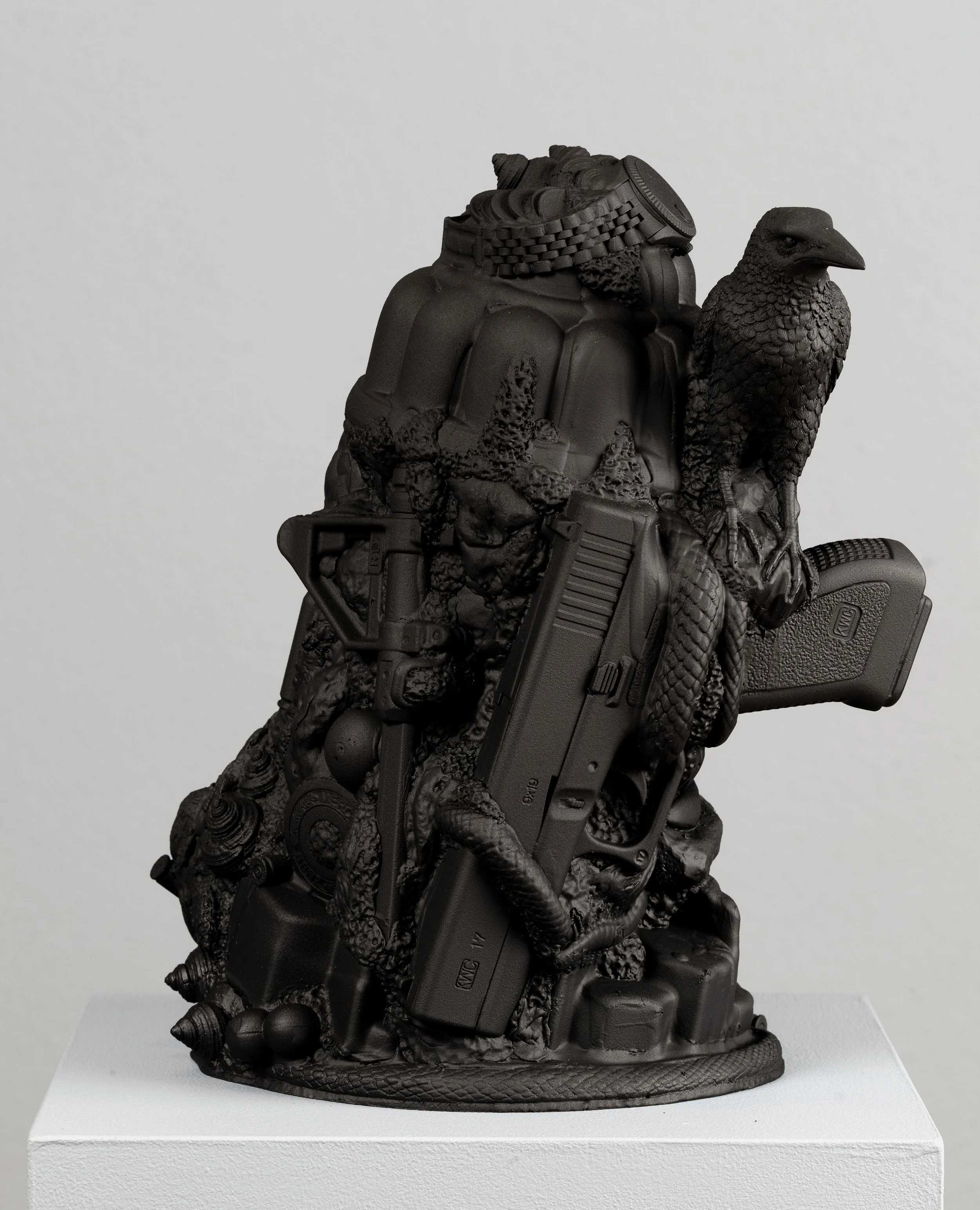
The four sculptures on the show extend this conversation materially, I’ve come to think of these works as triumvirates of dissonance: objects that straddle the line between durability and disposability, monumentality and neglect—that riff variously on notions of permanence in an age obsessed with obsolescence. The polyurethane Beyond the Chrysanthemum presents a critical reflection on the disillusionment of ideological aspirations and the remnants of cast-off dreams. The piece feature a modest, chaotic pile of objects that encapsulate the complexities of power and conflict, variously functioning as symbols for violence, commodification, materialism, capitalism’s encroachment on revolutionary ideals as well as socio-political hierarchies. A small crow, perched atop the assemblage, further evokes themes of scavenging and survival—a sifting through these remnants of cast-off dreams. Drawing inspiration from Vladimir Tatlin’s Monument to the Third International the work offers a sobering appraisal of failed ideologies. While the polyurethane medium lends impermanence to these fleeting symbols of aspiration and loss—the fragility of hope amidst the harsh realities of history and the contradictions inherent in the pursuit of a better world.
The exhibition itself has been designed, in parts, with a symmetry that might initially suggest a kind of formal reassurance. This is, of course, a trap. The symmetry is meant to lull the viewer into an expectation of order before gradually confronting them with the creeping suspicion that everything they are looking at is, in some sense, a hall of mirrors reflection. And is where notions of a doppelgänger enter—not the romantic, Byronic double, but the vanitas-inflected twin that whispers: “You too are complicit, and you too will end.” This doppelgänger is not meant to be a simple mirror image but a shadow self, a silent witness to a life unlived or a path not taken. I’ve often wondered if it’s my more successful, less disillusioned counterpart, or perhaps merely the logical conclusion of the doppelgänger in a system of infinite growth: a parallel version of ourselves—digital twins—endlessly consuming and producing in a world that can no longer sustain it.
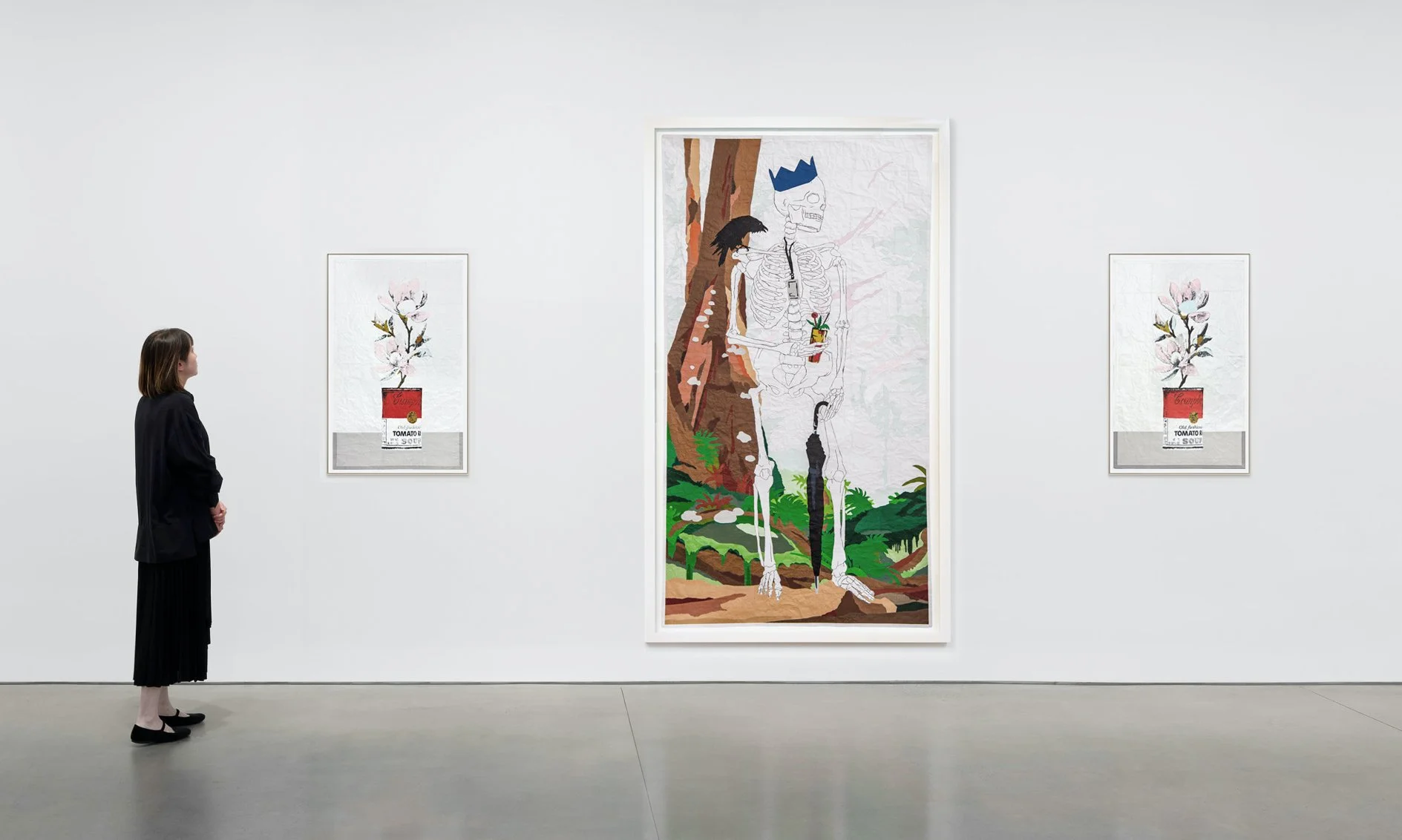
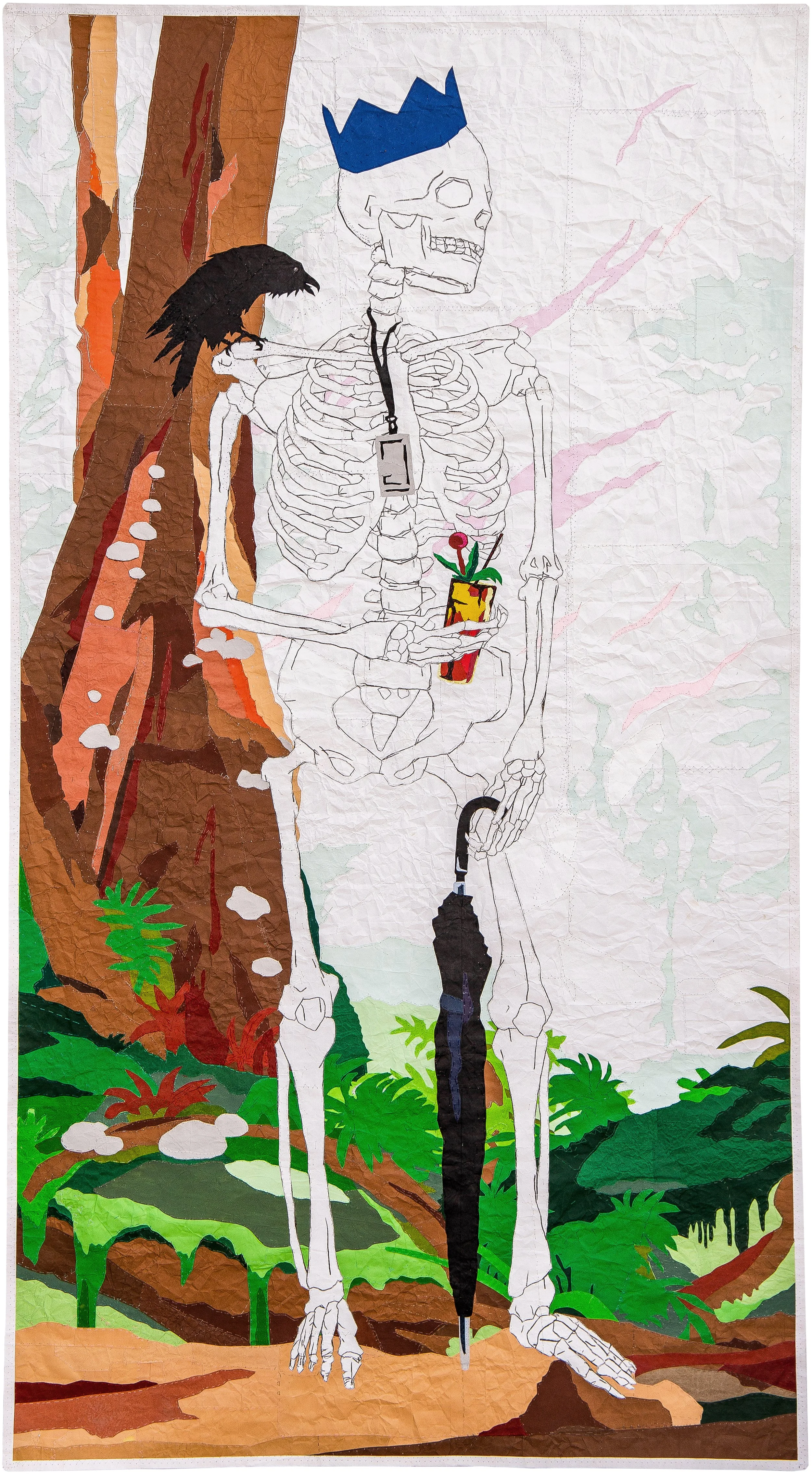
Ultimately, The Long Run is not solely concerned with dominance, but slippages in the cracks of its foundations, conjecture as to alternative futures and who constructs power, who benefits, and where the cost lies. Or what happens when hegemonic forces override communal ones. Underwritten by the mechanical war cry of: Let’s Go! Hubris! Let’s Go! silently chanted by the passively smug yet very dead office worker as featured in the Tontine work For a beautiful moment in time we created a lot of value for shareholders. The skeletal figure at the centre of the work combines both the motifs of a memento mori and a vanitas. The piece functions in the play of tensions created between the allegorical representation of a higher ideal (mortality versus hubris, etc) and a simultaneous satirical view of that very ideal through the optic of the work also being a case for low key hedonism; You-only-die-once (YODO) or “I’m here for a good time, not a long time”—both seemingly the battle cries of late-stage capitalism. These themes manifest in the bucolic Alpine background of the composition as well as in the paper party hat that crowns the skull, an emblem historically reserved for emperors and kings. As such the work variously interested in a visual allegory for the physical and ideological scaffolding of power. The king not only has no clothes, as it were—but no skin, tissue or organs, stripped bare to the chassis. He is also seemingly enjoying a drink while wearing his corporate office access card on a lanyard at the company’s year-end results presentation. Something I do annually in my other work life and at 181cm tall the skeleton is exactly my height life-size. This skeleton functions not as a morbid self-portrait but maybe more as a way of making myself complicit in the critiques, contexts, messages and humour the work—and more broadly this exhibition—is concerned with.
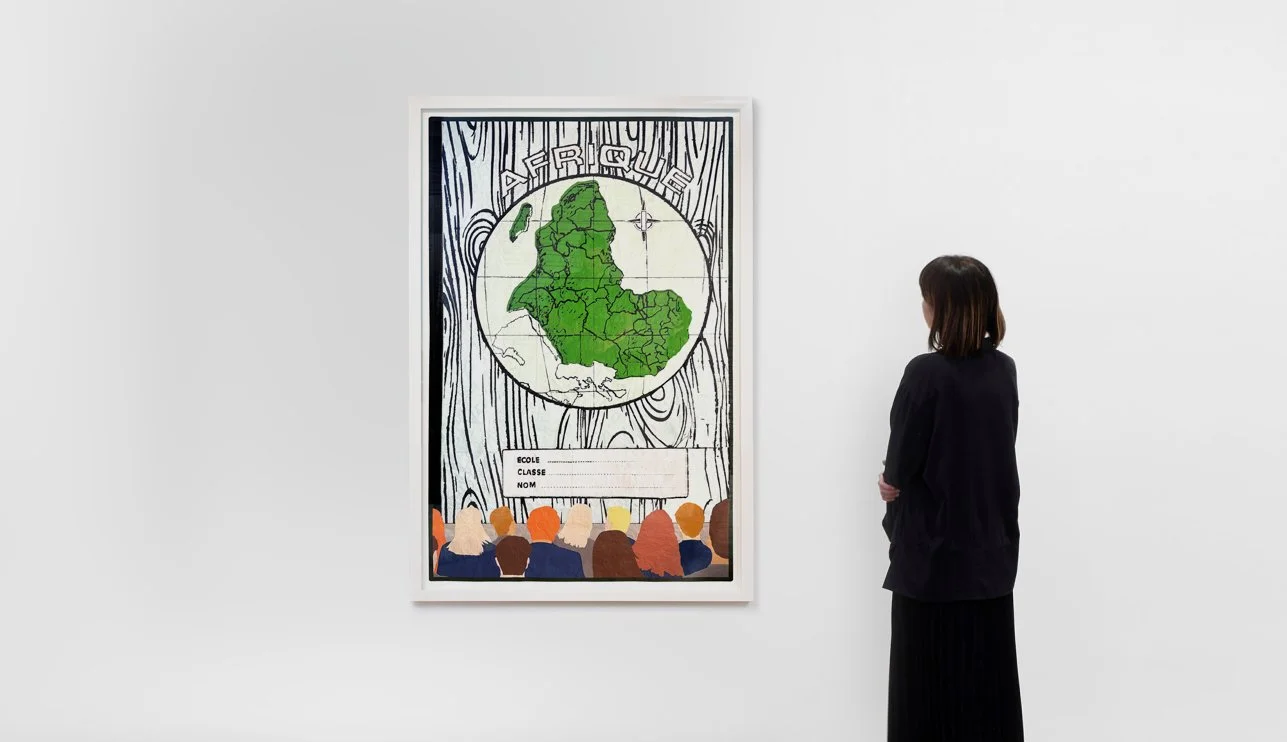
Another new work titled School’s Out Forever – features in the foreground of its composition a similar group of corporate people ‘enjoying’ a PowerPoint presentation, or viewing an outsized artwork or waiting at a stop street to cross the road opposite a giant billboard. The Presentation/artwork/billboard in the a motif’s background shows an adapted cover design from an original textbook produced by Cahiers SAFCA: African Notebook Manufacturing Company, ornamented with faux wood panelling. Founded in 1970 in Douala, Cameroon—Cahiers SAFCA is a firm whose published educational materials have shaped young intellectual minds in the West African region for generations. Although largely redolent I have altered the original textbook cover to a subverted geography of the traditional cartographic representations of Africa, with the idea that the standardisation of knowledge through such maps has, in one sense, historically functioned as tools of control. These forms of coercion are defined in this context in terms of the imposition of fictional, arbitrary nation-states following the General Act of Berlin (1885). A concept so at odds with reality that the consequences continue to be felt in multiple contexts across the continent today.
For a beautiful moment in time we created a lot of value for shareholders
Reclaimed packaging paper, cotton, conté crayon, acrylic, archival tape
200 x 116 cm
Beyond the Chrysanthemum I
Pigmented poly-urethane
Ed. 1/5
32 x 26 x 21 cm
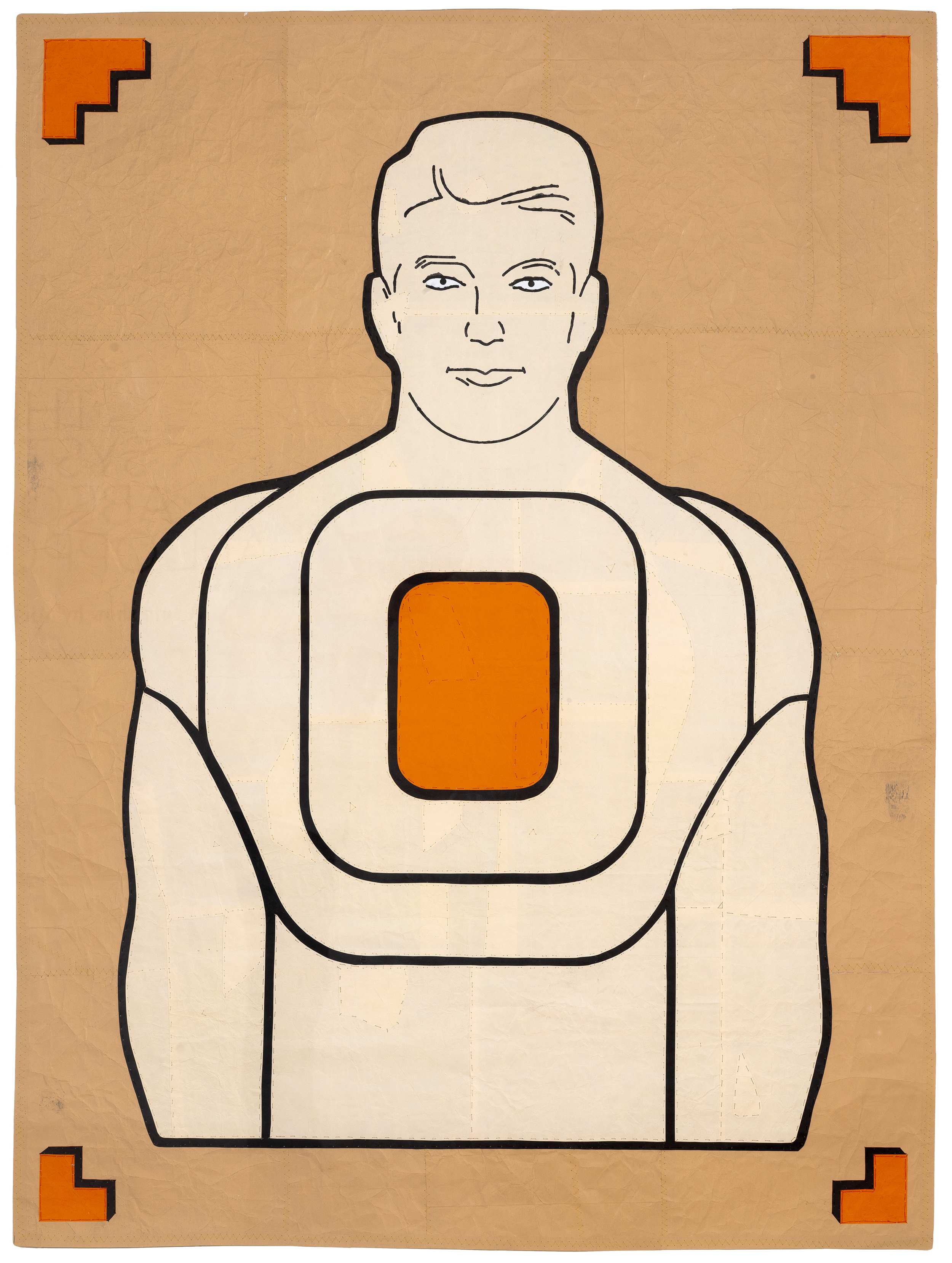
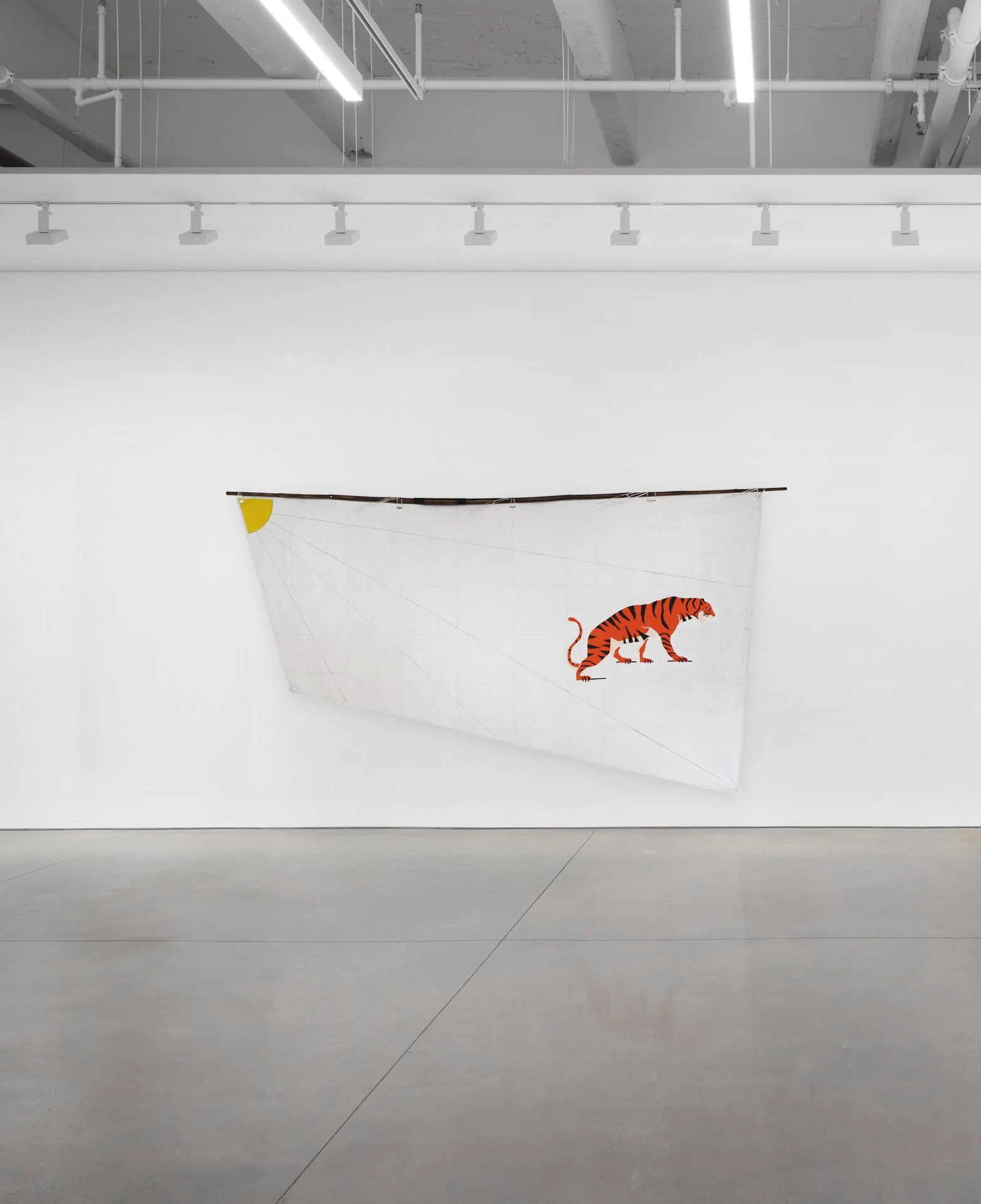
Zhilaohu
Reclaimed packaging paper, cotton, twine, bamboo
300 x 250 x 8 cm